Anki AI Flashcard Copilot
A Python desktop Anki add-on integrating LLM APIs into the card editor to automate flashcard generation, Cloze deletions, and medical mnemonics.
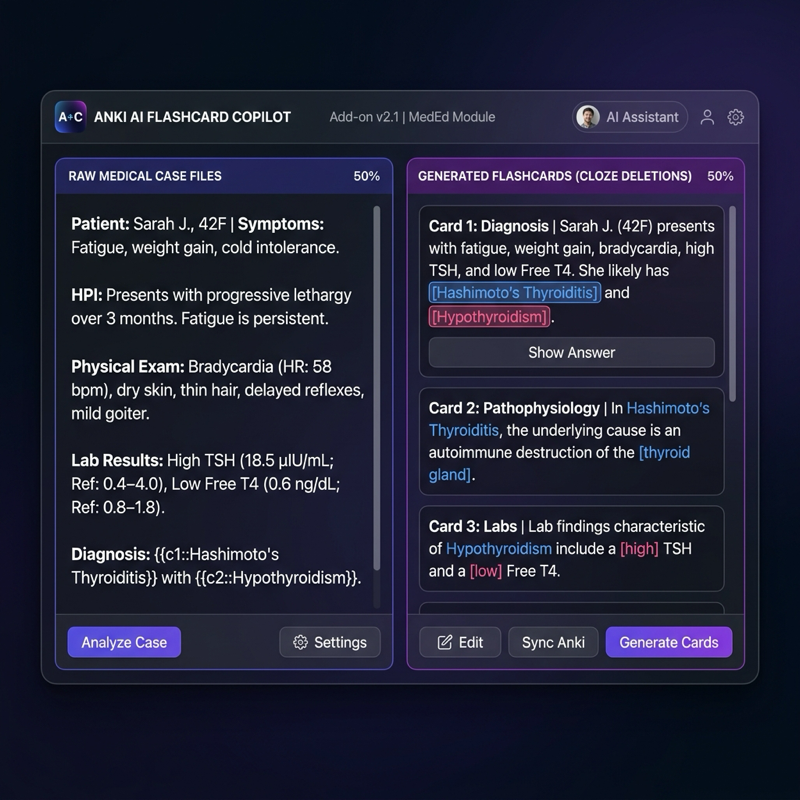
Anki AI Flashcard Copilot
The Anki AI Flashcard Copilot is a custom desktop plugin built for the open-source flashcard program Anki. Designed to streamline study prep for medical and science students, the add-on integrates directly with local and cloud-based LLM APIs. With a single keyboard shortcut, students can transform textbook paragraphs or lecture notes into high-yield, formatted Cloze deletion flashcards.
The Bottleneck
Active recall and spaced repetition (Anki) are the gold standards for memorizing the massive volume of information required in medical school. However, card creation is a major bottleneck. Creating high-quality flashcards—breaking down paragraphs into bite-sized questions, identifying key terms for Cloze deletions ({{c1::like this}}), and adding clinical summaries—takes hours of manual typing every day.
The Solution
This add-on embeds an AI panel directly inside the Anki card editor interface. When a user pastes raw clinical notes into the input field and hits Cmd+Enter, the Copilot analyzes the text, extracts the high-yield facts, and drafts cards automatically.
+-----------------------------------------------------------+
|                    Anki Card Editor Window                |
+-----------------------------------------------------------+
|  [Notes Input Panel]                                      |
|  "A 45-year-old male presents with crushing chest pain... "|
+-----------------------------------------------------------+
                             | (Cmd+Enter Shortcut)
                             v
+-----------------------------------------------------------+
|                    AI Copilot Add-on Panel                |
|  - Compiles system prompts for medical card structure     |
|  - Queries API proxy gateway                              |
+-----------------------------------------------------------+
                             |
                             v
+-----------------------------------------------------------+
|                    Anki Card Output Fields                |
|  - Front: "A 45-year-old male presents with {{c1::chest   |
|            pain}} radiating to the {{c2::left arm}}..."   |
|  - Back: High-Yield Clinical Pearls & Mnemonics           |
+-----------------------------------------------------------+
Technical Architecture
1. PyQt GUI Integrations
Anki is written in Python and uses Qt (PyQt6) for its user interface. The add-on extends Anki’s editor menu by dynamically injecting custom sidebar widgets and keyboard event listeners into the Editor class lifecycle, providing a native look and feel.
2. High-Yield Cloze Parsing
Standard LLMs often struggle to create Anki cards in the correct markdown format. The Copilot uses custom system templates instructing the model to return card text containing proper Anki syntax:
- Cloze identifiers (
{{c1::term}}) placed only on diagnostic names, drug mechanisms, or clinical markers. - HTML bolding tags (
<b>) on key findings to improve reading efficiency during card reviews.
3. API Proxy & Key Management
To prevent exposing private API keys in shared scripts, the add-on coordinates request signing. It allows users to input their own keys in a settings dialogue box, which are then saved locally using secure SQLite/Anki profile configurations.